
You probably have a system for most things in your life. And you probably get frustrated when other people don't.
That frustration tells you something real about your high conscientiousness personality and how your brain is wired relative to everyone else's. Scoring in the 70th percentile or above on Conscientiousness puts you in a category that psychologists have spent decades studying for one simple reason: it works. High-C individuals outperform on nearly every outcome that society rewards. Academic achievement, job performance, income, longevity. The research on this is not compelling and overwhelmingly consistent.
But "it works" is not the same as "it's easy." And high Conscientiousness comes with real costs that rarely get discussed honestly.
What High Conscientiousness Feels Like
You probably planned your week before it started. Maybe Sunday night, maybe Friday afternoon before you left. Either way, you had a plan. You follow through. Deadlines aren't stressful because you finished three days ago.
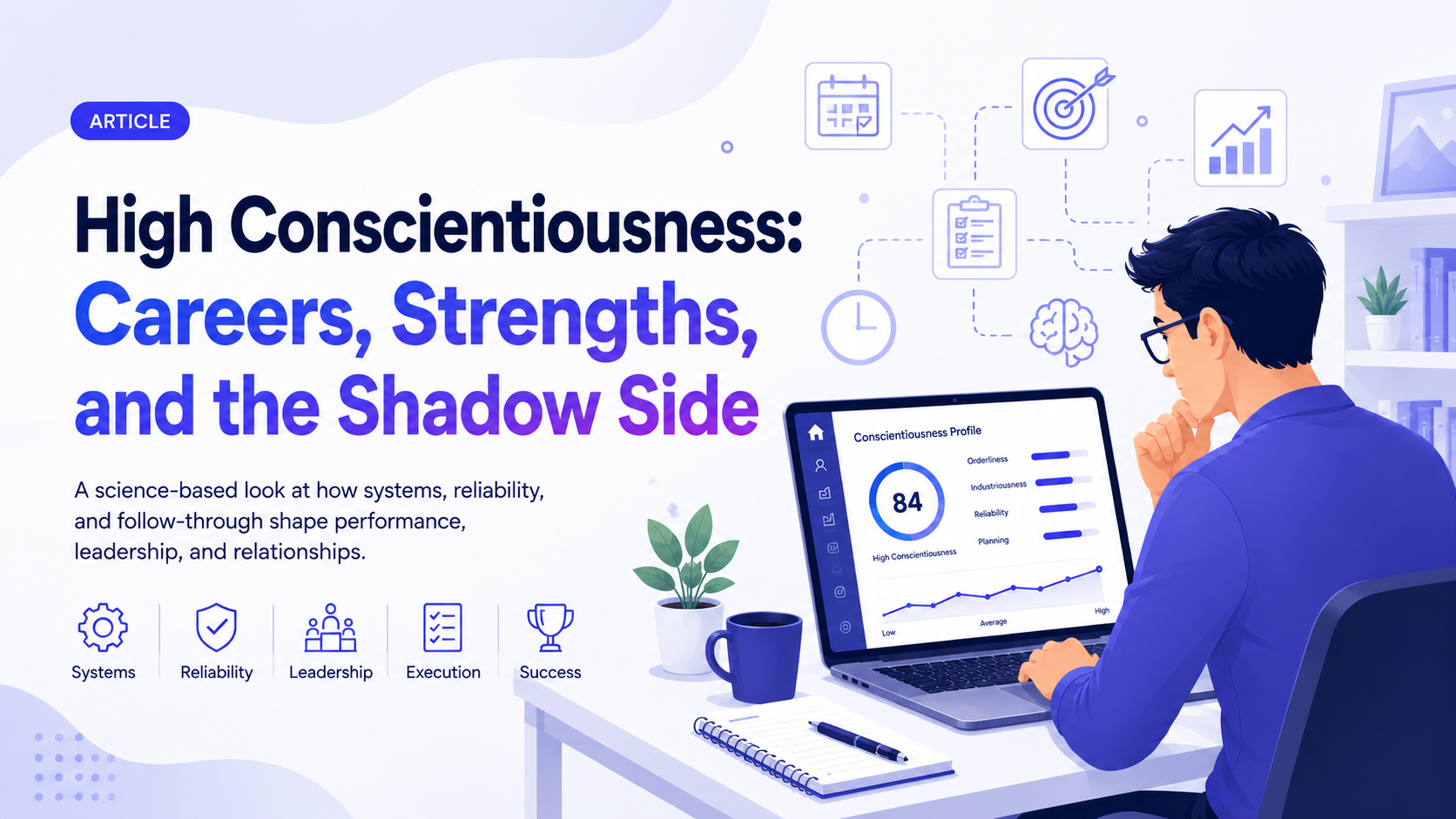
Your space may or may not be physically tidy. Conscientiousness has two sub-components: Orderliness and Industriousness. You can score high on one and moderate on the other. A high-Industriousness, moderate-Orderliness person might have a chaotic desk but zero missed deadlines. The common thread isn't neatness. It's the internal architecture that pushes tasks to completion.
Roberts and Inzlicht's 2024 research clarified something that a lot of high-C people find useful to hear: you don't succeed because you have more willpower. You succeed because you build systems that make discipline automatic. The distinction matters. Willpower-first strategies are exhausting and brittle. System-first strategies are what you're actually doing when you're performing at your best. You avoid situations where temptation or distraction can get a foothold.
Barrick and Mount's landmark 1991 meta-analysis established Conscientiousness as the single strongest Big Five predictor of job performance across virtually every occupational category (Barrick & Mount, 1991). Schmidt and Hunter's later work confirmed that Conscientiousness, combined with cognitive ability, creates a particularly powerful performance advantage (Schmidt & Hunter, 1998). The science here is unusually consistent. High-C people produce.
High Conscientiousness at Work
If you're wondering which high conscientiousness careers suit you, the answer is: almost anything that rewards sustained precision, reliability, and follow-through. Management, medicine, law, engineering, finance, military leadership, project management, surgery, executive roles. These fields are built for high-C people.
You're the person companies build around. Not the flashiest. Not always the most creative. But extremely reliable and difficult to replace. When you say something will be done, it gets done. When you take responsibility for an outcome, you actually feel responsible for it.
Your leadership style tends toward structure. Clear expectations, defined processes, high standards. People who work for you know exactly what's expected and they know you'll notice if it isn't delivered. That clarity can be a gift. It can also be a pressure cooker depending on your flexibility.
The pitfalls are real and they're worth knowing about. Perfectionism can slow you down more than it improves your output. Rigidity can make you expensive to work with when circumstances change fast. Difficulty delegating, because you genuinely believe you'll do it better yourself (and you're often right), creates bottlenecks. Frustration with less disciplined colleagues can curdle into contempt if you're not careful. And the same drive that makes you excellent at execution can quietly push you toward burnout if you hold yourself to high standards for a long period of time.
In MBTI terms, Judging types, particularly ISTJs, ESTJs, INTJs, and ENTJs, most frequently score high on Conscientiousness. The J preference for closure, structure, and completion maps directly onto the trait's core behaviors.
If you want to understand how your Conscientiousness interacts with your cognitive ability and your other trait scores, TalentRank's full assessment gives you the complete picture across all five factors plus IQ.
High Conscientiousness in Relationships
As a partner, you're reliable in a way that most people are not. You follow through on what you say. You show up. You remember the thing you said you'd handle two weeks ago because it's still on your internal list. That consistency creates genuine safety for people who've been let down by less structured partners.
The friction surfaces elsewhere. You may come across as rigid, or as having expectations that feel like pressure. Spontaneity can genuinely feel uncomfortable, not because you don't value fun but because unplanned things require tolerating ambiguity you'd prefer to resolve. Partners who score lower on Conscientiousness may experience your standards as judgment rather than preference.
And sometimes they're right. When your internal model says "this is how a reasonable adult operates," it's easy to stop seeing that as a personal preference and start seeing it as an objective standard. That slide is worth watching.
High Conscientiousness Combined with Other Traits
High C + High Openness creates the strategic innovator. The drive to execute meets the appetite for novel approaches. These people can build genuinely new things, not just optimize existing ones.
High C + Low Agreeableness produces the demanding achiever. High standards, strong opinions, no instinct to soften either. These people set the bar high and hold others to it. They can be difficult to work for and extremely effective. Often both at once.
High C + Low Neuroticism creates a profile that performs well under pressure without the emotional volatility that derails other high performers. Calm, reliable, consistent delivery even in adverse conditions.
High C + High IQ is the combination Schmidt and Hunter's research points to most directly. High cognitive ability tells you what the right answer is. High Conscientiousness makes sure you actually implement it. Either trait alone has limits. Together they compound.
Common Challenges and Growth Areas
Perfectionism is the shadow side of high conscientiousness, and it's worth treating seriously. The same internal mechanism that drives excellent execution also makes it genuinely hard to ship imperfect work, hand off tasks to less precise people, or take risks where outcomes are uncertain. These aren't character flaws. They're the same trait applied in contexts where it doesn't serve you.
The 80/20 principle is harder for high-C people than it is for almost anyone else. Not harder to understand. Harder to accept. That the last 20% of quality often requires 80% of effort and delivers limited marginal value is intellectually obvious and experientially uncomfortable. Shipping at 85% can feel like failure even when 85% is exceptional relative to everything else in the market.
Flexibility is the second growth edge. Some situations genuinely require improvisation, tolerance for ambiguity, and the ability to change direction mid-execution. Your instinct is to build a plan and work the plan. That instinct serves you most of the time. But the times it doesn't serve you are often high-stakes moments where rigidity is most costly.
The goal is to learn which situations call for your default strengths and which ones need you to hold the reins a little looser.
Frequently Asked Questions
Is high conscientiousness always good?
High Conscientiousness is the most consistently predictive Big Five trait for positive life outcomes across education, career, and health (Barrick & Mount, 1991). But it has a shadow side. Perfectionism, rigidity, and difficulty tolerating ambiguity are real costs that come with the same internal wiring. Whether it's "good" depends on whether you're applying it in the right contexts.
What careers are best for highly conscientious people?
The high conscientiousness strengths of precision, reliability, and sustained follow-through map best to roles with clear standards and defined outcomes: medicine, law, engineering, project management, finance, executive leadership, and the military. That said, high-C individuals can perform well in almost any field because Conscientiousness predicts general job performance across occupational categories.
Can you be too conscientious?
Technically, yes. Very high Conscientiousness can shade into perfectionism and rigidity that reduces output quality or creates interpersonal friction. But in most real-world contexts, the performance benefits of high Conscientiousness outweigh the costs. The issue is usually not the trait itself but applying it in situations that call for flexibility and adaptability.
Ready to see your full trait profile? TalentRank combines Big Five personality assessment with ICAR-16 cognitive testing to generate a personalized report on your strengths, your career fit, and the specific trait combinations that define how you operate.
Sources
Barrick, M. R., & Mount, M. K. (1991). The Big Five personality dimensions and job performance: A meta-analysis. Personnel Psychology, 44(1), 1-26.
Roberts, B. W., & Inzlicht, M. (2024). Conscientiousness and self-regulation: Systems over willpower. Psychological Review.
Schmidt, F. L., & Hunter, J. E. (1998). The validity and utility of selection methods in personnel psychology: Practical and theoretical implications of 85 years of research findings. Psychological Bulletin, 124(2), 262-274.