
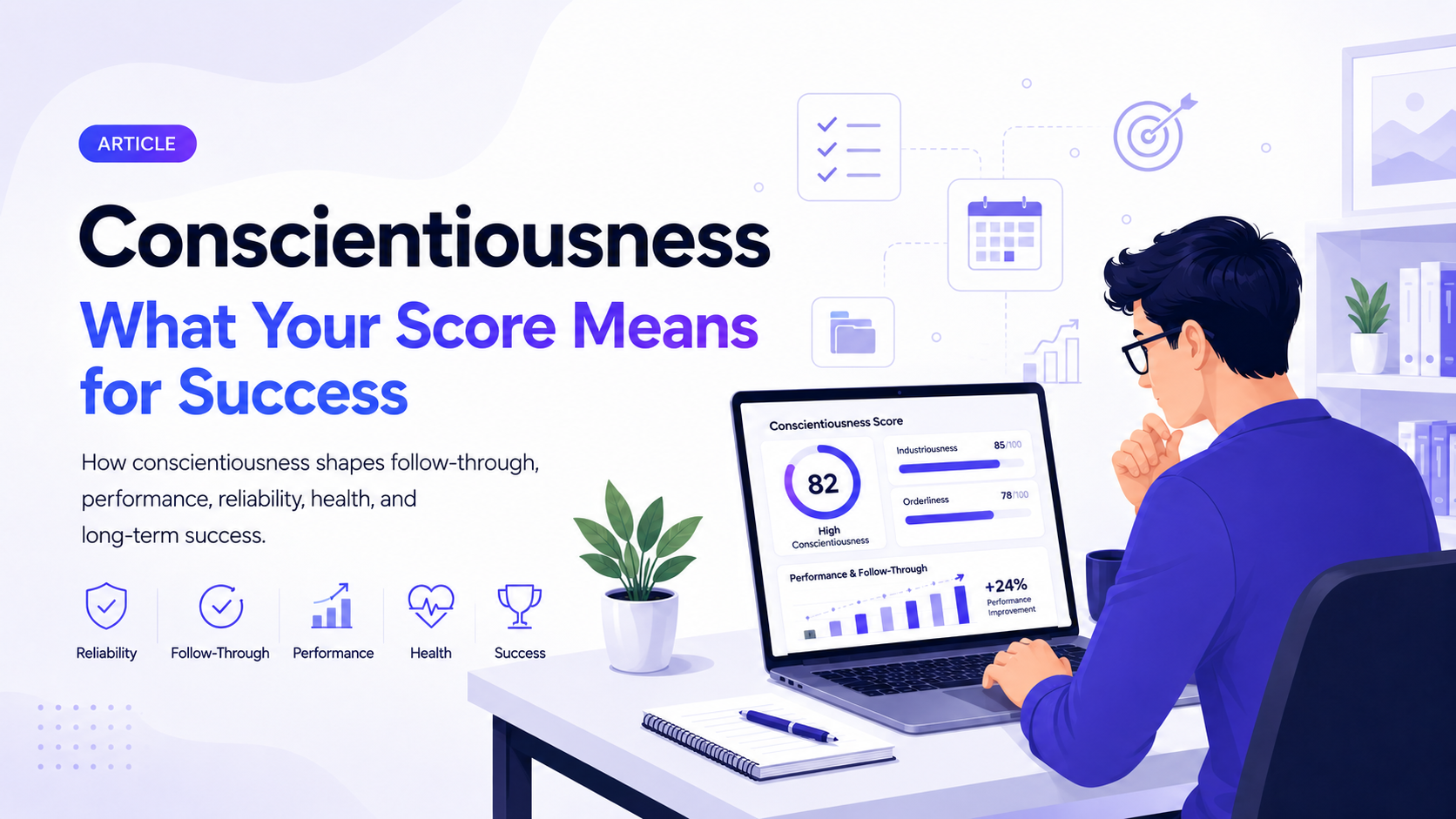
Think about the person in your office who color-codes their calendar, arrives five minutes early to every meeting, and somehow finishes every project before the deadline. Now think about the person whose desk looks like a filing cabinet exploded but who never, ever misses a commitment. Both of them score high on Conscientiousness. The trait is wider than tidiness.
Conscientiousness is the most consequential of the Big Five personality traits for predicting real-world success. It predicts job performance better than any other personality measure. It predicts how long you live. It shapes your income, your health behaviors, and whether the people in your life can count on you. If you just got your TalentRank score and Conscientiousness is on your radar, this page covers what the research actually says, why the popular story about willpower is wrong, and what your score actually means for you.
What Conscientiousness Actually Measures
Conscientiousness measures the degree to which a person is organized, dependable, goal-directed, and able to regulate their own behavior in service of long-term outcomes. It is not the same as intelligence. It is not the same as motivation. It is the personality infrastructure that determines whether your intentions actually translate into actions.
Psychologist Colin DeYoung and colleagues (2007) identified two distinct aspects within Conscientiousness that are worth separating because they have different causes and different effects.
Industriousness: The Drive Facet
Industriousness captures drive, self-discipline, achievement striving, and follow-through. It is the facet that pushes someone to start a project, sustain effort when things get tedious, and keep working toward a goal even when the payoff is distant. People high on Industriousness do not need external pressure to get moving. They generate their own.
This is also the facet most tightly connected to income and career advancement. A person who is high on Industriousness but moderate on Orderliness might have a chaotic workspace and no formal system, but they hit every deadline and finish what they start.
Orderliness: The Structure Facet
Orderliness captures the preference for structure, routine, cleanliness, neatness, and rule-following. People high on Orderliness feel genuinely uncomfortable with clutter and ambiguity. They want a system. They want to know the process. They want the world to be predictable and organized.
The two aspects are separable. Someone can be high on Industriousness and moderate on Orderliness (the hardworking creative who operates in apparent chaos), or high on Orderliness but moderate on Industriousness (the person with a perfect filing system who procrastinates anyway). Your TalentRank report captures the overall Conscientiousness score, but knowing which facet is driving it is often the more actionable insight.
The Conscientiousness Spectrum: Low to High
Conscientiousness is normally distributed. Most people fall somewhere in the middle. Here is what each range of the spectrum tends to feel like from the inside.
High Conscientiousness (70th percentile and above)
You plan your week on Sunday night. You do not leave tasks unfinished if you can help it. Deadlines feel like a baseline, not a ceiling. You find it uncomfortable to let commitments slip. At work you are reliable to a degree that others notice, and probably rely on. The risks at high levels include rigidity, difficulty delegating, and frustration with people who operate more loosely. The tendency to take on too much, and then be hard on yourself when results fall short of perfect, is common.
[Link: High Conscientiousness]
Medium Conscientiousness (35th to 69th percentile)
You can be disciplined when the stakes are high, and considerably less disciplined when they are not. You meet important deadlines but probably not every small one. You have systems, but they do not always hold. Context matters a lot: you might be highly conscientious at work and fairly relaxed about it in your personal life. This is the most common range, and it comes with flexibility.
[Link: Medium Conscientiousness]
Low Conscientiousness (below 35th percentile)
Structure feels like a cage. You resist routine even when you intellectually know it would help. You start things you do not finish. The immediate is more compelling than the important. Your best work often happens in bursts, close to a deadline, fueled by urgency rather than planning. There are some strengths here, particularly in roles that reward spontaneity, creative exploration, and the ability to pivot quickly. The challenge is designing your environment so that your natural style does not create unnecessary friction with others.
[Link: Low Conscientiousness]
What Conscientiousness Predicts: Career, Relationships, Health
Career Performance
Conscientiousness is the single strongest personality predictor of job performance across virtually all occupations. Barrick and Mount's 1991 meta-analysis, which reviewed 162 studies covering over 23,000 subjects, established that Conscientiousness predicts job performance consistently regardless of occupation type. Schmidt and Hunter's 1998 analysis extended this finding and confirmed that when you combine Conscientiousness with cognitive ability, you get the most powerful non-interview predictor of job success available.
The reason is not what most people assume. The popular story is that conscientious people succeed because they have more willpower, that they white-knuckle their way through temptation better than the rest of us. Research from Roberts and Inzlicht (2024) contradicts this directly. Conscientious people do not exert more self-control in the moment. They build systems that make self-control unnecessary. They plan ahead so that they are rarely in a position where willpower is needed. Success comes from designing the environment, not from resisting impulse harder.
This finding has practical implications for everyone at every level of the trait. The question is not whether you have willpower. The question is whether your environment is designed to make the right behavior the default. Conscientiousness is as conscientiousness does, so to speak.
Relationships
High Conscientiousness predicts relationship stability. Conscientious people follow through on commitments, show up when they say they will, and manage conflict in a more measured way. They are the partners who remember things, plan ahead for the family, and do not disappear when something gets hard.
The potential downside is rigidity. Very high scorers can be genuinely difficult to live with if their partner scores lower, because the gap between how each person manages time, space, and responsibility becomes a recurring source of friction. The high Conscientiousness person experiences the low scorer as irresponsible. The low scorer experiences the high scorer as controlling. Both readings contain some truth.
MBTI Connection
If you are familiar with the Myers-Briggs framework, the Judging/Perceiving dimension maps most directly onto Conscientiousness. Costa and McCrae (1989) found a moderate correlation between the J preference and higher Conscientiousness scores. If you identify as an ISTJ or ENTJ, your Judging preference is consistent with a higher Conscientiousness score. If you identify as an ENFP or INTP, your Perceiving preference suggests lower Conscientiousness, though your actual score may vary considerably depending on domain and life context. MBTI is a useful orientation, but the Big Five score gives you the real number.
Health and Longevity
Conscientiousness is one of the most robust personality predictors of physical health and lifespan. Friedman and Martin's longitudinal research found that conscientious people live significantly longer. They exercise more consistently, eat more carefully, drink less, smoke less, and are more adherent to medical advice. They are less likely to engage in impulsive risk-taking. The health effect is not just about behavior; there is evidence that Conscientiousness is associated with lower chronic stress and better immune function over time. It may be the single most health-relevant personality trait.
How Conscientiousness Interacts with Other Traits
Conscientiousness does not operate in isolation. Its effects are amplified or constrained by the other traits in your profile. A few of the most important interactions:
High Conscientiousness + High Openness: The strategic innovator. You generate new ideas and you execute them. This is a rare and productive combination. The risk is overcommitment: too many projects started because both traits drive initiation.
High Conscientiousness + Low Agreeableness: The demanding achiever. You set a high bar and expect others to meet it. You are effective and often highly respected, but can be experienced as hard to work with. The drive to get things done right does not always accommodate other people's processes.
Low Conscientiousness + High IQ: The brilliant underperformer. This may be the most frustrating profile in the literature. High intelligence creates capability; low Conscientiousness undermines follow-through. The result is chronic underperformance relative to potential, which compounds over time.
The Conscientiousness and IQ interaction deserves special attention. The two traits are essentially uncorrelated, meaning you can have any combination of them. When both are high, outcomes are strong. But the research is clear that moderate IQ combined with high Conscientiousness typically outperforms high IQ combined with low Conscientiousness across a career. Conscientiousness turns capability into output. Without it, intelligence tends to go to waste.
Can You Change Your Conscientiousness?
Among the Big Five traits, Conscientiousness is the most amenable to deliberate change. This is not universally true of personality, and it is worth being honest about that. Introversion does not become extraversion through effort. But Conscientiousness is different.
Nick Hudson's 2021 research found that behavioral interventions can shift Conscientiousness even without personal motivation to change. The mechanism is habit formation, not willpower. When people were simply asked to perform conscientious behaviors, including organizing their space, scheduling tasks in advance, and starting work earlier than usual, their trait scores shifted over time. The behavior came first and the personality followed suit.
This is a significant finding because it removes the usual catch-22 of personality change. You do not need to want to be more conscientious before acting more conscientiously. You just need to act that way long enough for it to become default.
The concept of domain specificity is also relevant here. Conscientiousness is not uniform across your life. You might be highly conscientious at work and considerably less so at home. The Big Five score is an average. That means the question for most people is not, "How do I become conscientious?" but rather, "How do I extend the conscientiousness I already demonstrate in some contexts to other areas where I need it?"
Applied practically, the Roberts and Inzlicht finding means: design your environment before you need to rely on your resolve. Put the gym bag by the door. Block the time on your calendar before the week fills up. Remove the friction from the behavior you want to do more of. Conscientious people are not better at resisting temptation. They arrange their lives so that temptation is rarely the variable in play.
Frequently Asked Questions
What does it mean to be highly conscientious?
High Conscientiousness means your natural orientation is toward organization, follow-through, reliability, and goal-directed behavior. You tend to plan rather than improvise, meet commitments rather than renegotiate them, and be uncomfortable leaving things unfinished. At work, you are typically seen as dependable and thorough. The trait also carries risks, including rigidity, perfectionism, and difficulty accommodating ambiguity or change.
Is conscientiousness the most important personality trait?
For predicting life outcomes, it has the best case. It is the strongest Big Five predictor of job performance, income, health behaviors, and longevity. Emotional Stability matters more for wellbeing and mental health. Openness matters more for creative and entrepreneurial success. But if you had to bet on one trait predicting whether someone would perform well and live long, Conscientiousness would win.
Can you become more conscientious?
Yes, and more so than most other traits. Hudson (2021) showed that simply performing conscientious behaviors shifted the trait over time. You do not need to feel motivated before starting. You need to build habits, design your environment, and let your personality catch up to your behavior. This takes months, not days, but the research supports that it works.
What careers suit low Conscientiousness?
Roles that reward spontaneity, creative bursts, rapid adaptation, and tolerance for ambiguity tend to fit lower-Conscientiousness profiles better. Think entrepreneurial early-stage environments, creative direction, journalism, emergency response, and roles where rigid process would actually get in the way. The challenge is that most organizations value reliability, so lower-Conscientiousness individuals often benefit from pairing with structured partners or building external systems that compensate for natural tendencies.
Is conscientiousness genetic?
Like all Big Five traits, Conscientiousness has a meaningful heritable component. Twin studies typically find heritability estimates around 40 to 50 percent. That means roughly half of the variance in Conscientiousness across people is explained by genetics. The other half is shaped by environment, experience, and behavior. The fact that it is partially heritable does not mean it is fixed. The Hudson (2021) findings make clear that behavior shapes the trait, regardless of where you started.
Key Sources
Barrick, M. R., & Mount, M. K. (1991). The Big Five personality dimensions and job performance: A meta-analysis. Personnel Psychology, 44(1), 1-26.
Schmidt, F. L., & Hunter, J. E. (1998). The validity and utility of selection methods in personnel psychology. Psychological Bulletin, 124(2), 262-274.
DeYoung, C. G., Quilty, L. C., & Peterson, J. B. (2007). Between facets and domains: 10 aspects of the Big Five. Journal of Personality and Social Psychology, 93(5), 880-896.
Roberts, B. W., & Inzlicht, M. (2024). The Fable of State Self-Control. Perspectives on Psychological Science.
Hudson, N. W. (2021). Personality changes via behavioral interventions. Journal of Personality.
Friedman, H. S., & Martin, L. R. The Longevity Project. Hudson Street Press, 2011.
Costa, P. T., & McCrae, R. R. (1989). The NEO-PI/NEO-FFI Manual Supplement. Psychological Assessment Resources.