

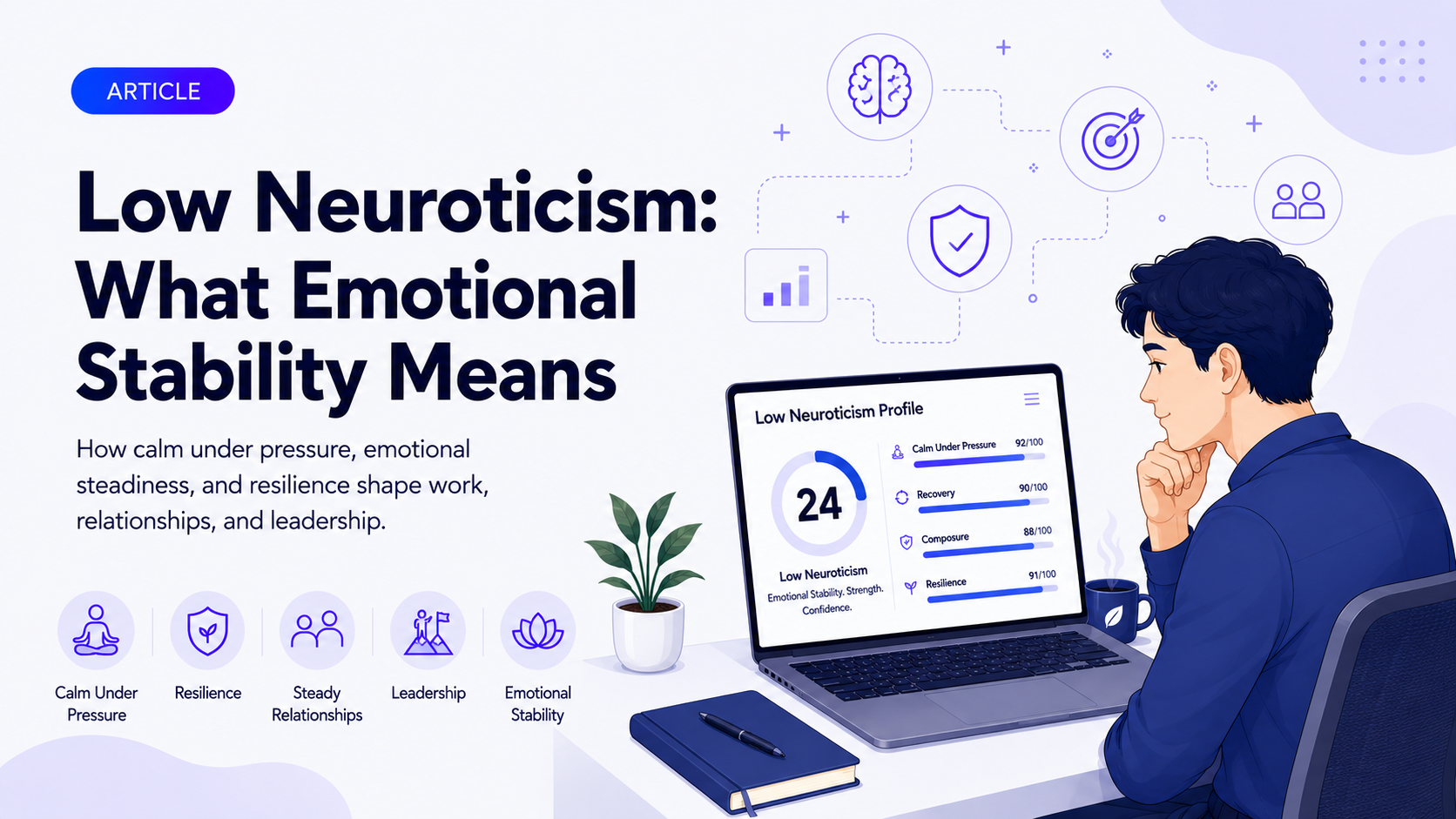
What Low Neuroticism Feels Like
You've probably watched someone spiral over an email that you read, shrugged off, and forgot about by lunch.
Low neuroticism, scored in roughly the 1st through 34th percentile on the Big Five personality model, means your baseline emotional reactivity is lower than most. Stress hits you, but it doesn't stick. A difficult conversation ends and you move on. A project falls apart and you're already thinking about what comes next instead of replaying what went wrong. The emotional weather passes faster for you than it does for most of the people around you.
This isn't suppression. Suppression is effortful, a deliberate tamping-down of feelings that builds internal pressure over time. What you're describing is something different: less intense negative reactions in the first place. Research by Lahey (2009) confirmed that neuroticism represents real differences in the intensity and duration of negative emotional experience, not merely differences in how people express or manage what they feel. Your nervous system isn't working overtime to stay calm. It just doesn't generate the same signal.
People with high emotional stability often describe a quiet internal dissonance: wondering whether something is wrong with them for not feeling more distressed. Friends lose sleep; you sleep fine. That's not a character flaw. But it's worth understanding what it costs you and what it gives you, because both are real.
Low Neuroticism at Work
This is where your trait becomes a structural advantage.
High-pressure environments select brutally for emotional stability. Crisis leadership, emergency medicine, surgery, military command, trading floors, trial law, entrepreneurship, and high-rejection sales all share one thing: the ability to think clearly when everyone else is starting to panic. That's you. And it's rarer than most people realize.
The calm you bring to a collapsing situation isn't just beneficial to you, it's contagious. When a team lead stays even-keeled as a deadline collapses or a client blows up, the team's cognitive performance follows upward. Research by Judge, Bono, Ilies, and Gerhardt (2002) found emotional stability to be among the most consistent Big Five predictors of both leadership emergence and leadership effectiveness. While you cope better under pressure, you actively stabilize others.
Roles with high ambiguity and low structure tend to reward this trait disproportionately. Founders who can sit with uncertainty for months without catastrophizing, traders who can absorb losses without their decision-making unraveling, surgeons who can work through a complication without their hands shaking, these are low-N profiles in action.
Your MBTI type can't show you this. But it might be the most important thing about your profile. MBTI captures preference and cognitive style. It doesn't capture how you respond when everything goes sideways. Neuroticism does. And in most careers that involve real stakes, that response pattern matters more than whether you prefer structure or spontaneity.
Low Neuroticism in Relationships
You are, for most people who know you well, the steady one. The person they call when things go wrong because they know you won't catastrophize alongside them. That role is valuable. It's also one you may underestimate, because it costs you so little to play it.
The friction shows up in a specific place: the gap between your emotional register and someone else's. You read a situation as manageable. They read it as a crisis. You respond accordingly, and they experience your calm as dismissiveness. "I don't see why this is a big deal" is probably the most accurate sentence a low-N person can utter, and also one of the most damaging things to say to someone who's currently in the middle of a big deal.
DeYoung, Quilty, and Peterson (2007) found that the facets of neuroticism involve not just emotional reactivity but also interpersonal sensitivity. High-neuroticism individuals pick up on emotional signals more acutely. Your lower reactivity means you may genuinely miss signals that they're broadcasting at full volume. It's not coldness. But from the outside, it can look exactly like coldness.
Building emotional fluency, meaning the ability to accurately track what another person is feeling and to communicate that you've tracked it, is the growth work for high-stability personalities. You don't need to manufacture distress. You need to close the empathy gap without pretending the gap isn't there.
Low Neuroticism Combined with Other Traits
Emotional stability doesn't operate in isolation. What it combines with shapes its expression in specific, recognizable ways.
Low N + Low Agreeableness produces the unflappable negotiator. Doesn't get rattled, doesn't people-please under pressure. Can hold a position through discomfort without flinching. Potentially reads as cold, but effective in adversarial contexts.
Low N + High Extraversion produces the natural executive. Energized by social interaction, unbothered by conflict, comfortable in visibility. This pairing tends to rise fast in organizations and often underestimates how differently most people experience the same situations.
Low N + High Conscientiousness produces the calm executor. Prepares thoroughly, doesn't spiral when plans deviate, finishes what they start. Lower drama, higher output. Often the most reliable person in any room.
Low N + High IQ is the combination that produces the surgeon who doesn't shake, the crisis negotiator who stays cool, the founder who doesn't self-destruct at the worst moment. Under cognitive load and pressure, emotional noise is the enemy of clear thinking. Low neuroticism means you access more of your actual cognitive capacity when the stakes rise. High-N individuals experience IQ degradation under threat; low-N individuals don't, or not to the same degree.
Common Challenges and Growth Areas
Stability is an asset. It's also a potential blind spot, in ways that are worth sitting with honestly.
The first is the empathy gap described above. Calm doesn't make you cruel, but it can make you distant without you realizing it. People in distress want to feel understood before they want to feel solved. Learning to say "that sounds genuinely hard" before offering a fix is a small behavioral shift with outsized relationship returns.
The second is complacency. Anxiety, for all its costs, is a performance system. It drives preparation. High-N people overprepare partly because they catastrophize, but the side effect is that they catch things. Without that anxious scanning, you may underprepare for low-probability bad outcomes, simply because the prospect doesn't generate enough internal discomfort to compel action. The best low-N performers build deliberate rehearsal habits to compensate for what anxiety normally drives automatically.
The third is threat detection. Research confirms that high-neuroticism individuals, precisely because they're scanning for danger more constantly, sometimes spot real problems earlier. They're not always crying wolf. Sometimes there's a wolf. Staying genuinely curious about what worried people are seeing, rather than dismissing their concerns as emotional noise, is one of the better habits a calm person can build.
FAQ
Is low neuroticism the same as not having emotions?
No. Low neuroticism means lower intensity and shorter duration of negative emotional reactions, not the absence of emotion. You feel things. They just don't linger the way they do for higher-N individuals. This is a biological and temperamental difference, not a coping strategy or a personality defect.
What careers suit emotionally stable people?
Any career with genuine high-stakes pressure tends to reward low neuroticism: surgery, emergency medicine, entrepreneurship, military leadership, trial law, financial trading, crisis management, executive leadership. The common thread is environments where cognitive performance under pressure is the differentiating factor. Stability also helps in high-rejection fields like sales, where the ability to absorb repeated no's without it accumulating emotionally is a real competitive edge.
Can you be too emotionally stable?
Yes, in specific ways. Insufficient anxiety can produce under-preparation, missed empathy cues, and poor threat detection. Relationships can suffer if stability reads as indifference. And in organizational contexts, leaders who can't emotionally attune to their teams sometimes miss early warning signs that something is wrong. Emotional stability is a foundation, not a ceiling. The best outcomes come from pairing it with developed empathy and deliberate attention to the moments when other people's anxiety is actually pointing at something real.