

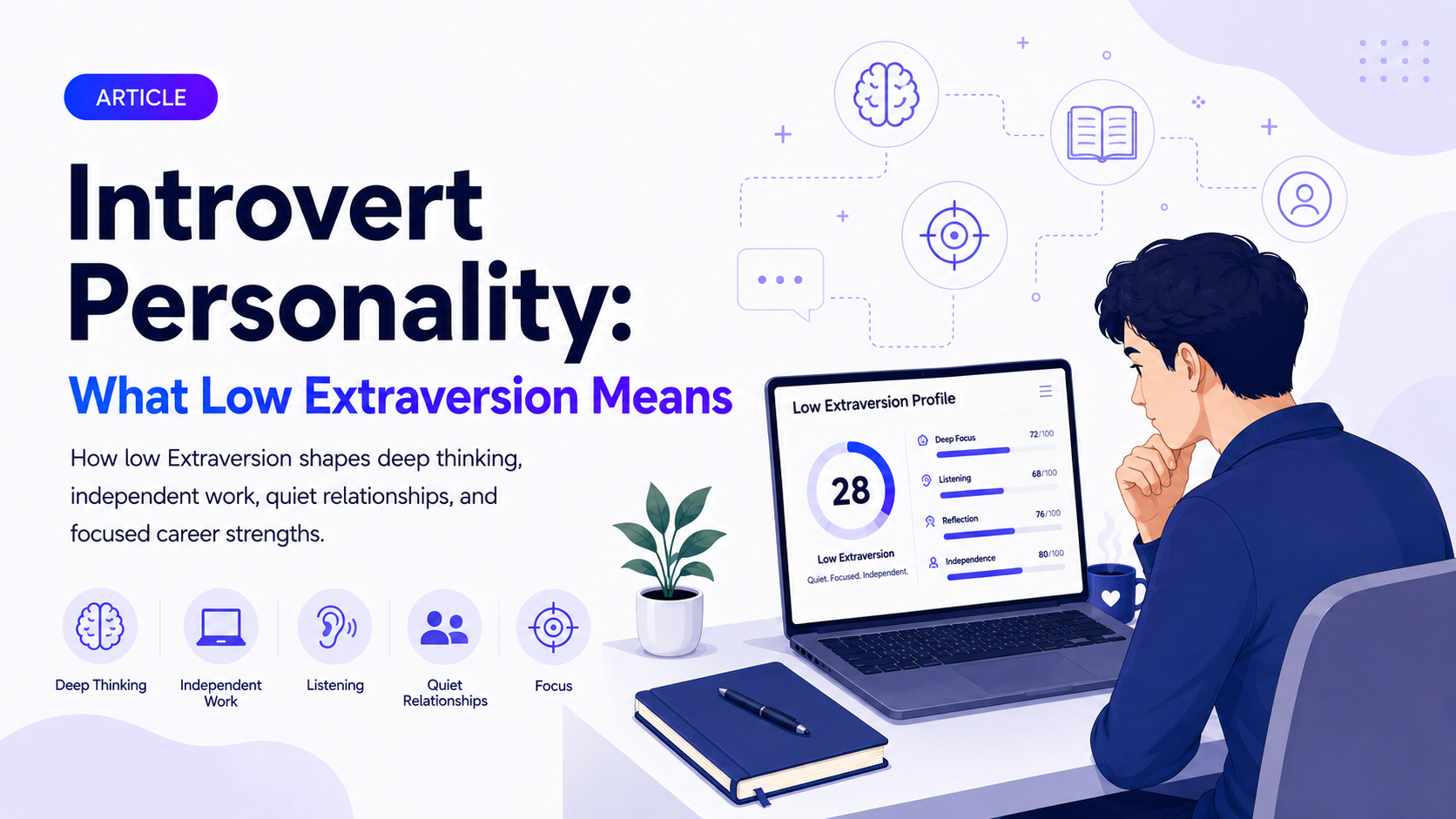
You probably do your best thinking alone. You might prefer a quiet night in as opposed to a large social gathering. You probably already know this and understand why… you’re introverted. What may surprise you is that the reason for that is quite a bit more interesting than “you recharge your social battery alone.”
If your introvert personality scored in the 1st through 34th percentile on the Big Five Extraversion scale, you’re in good company. It's one of the most stable, well-documented dimensions of human personality, studied across cultures and decades, and it tells you something real about how your brain is wired. Low Extraversion is a trait, and understanding it precisely changes how you see your own behavior, your work, and your relationships.
What Low Extraversion Feels Like
You probably have a rich inner life that most people never see.
Before you speak in a meeting, you've already run the argument three times in your head. You prefer one good conversation to a room full of small ones.
The neuroscience behind it is interesting. Psychologist Hans Eysenck proposed that introverts have a higher baseline level of cortical arousal than extraverts, meaning they reach an optimal stimulation threshold faster. More recent research by DeYoung (2013) links Extraversion specifically to dopaminergic systems: the reward circuitry that responds to social reward, novelty, and achievement stimuli. In people with low Extraversion, that system is simply less reactive. You don't get the same charge from a crowded room that an extravert does.
This is also where people conflate three different things that need to be kept separate. Introversion is a preference for lower-stimulation environments and a tendency to direct energy inward. Shyness is anxiety about negative social evaluation, a fear of judgment. Social anxiety is a clinical-level fear that impairs functioning. You can be introverted without being shy. You can be shy without being introverted. The three overlap sometimes, but they're not the same thing, and treating them as synonyms is sloppy thinking that causes real harm to introverts who get mislabeled as anxious or antisocial when they're neither.
What you are, if you score low here, is someone who processes deeply, recharges alone, and finds meaning in depth rather than breadth.
Low Extraversion at Work
The career implications of low Extraversion are significant enough that we've written an entire dedicated piece on them. If you want the full breakdown of which roles, industries, and work structures genuinely suit introverts, read our Best Careers for Introverts article.
The short version: environments that reward deep work, independent contribution, and careful judgment play directly to your strengths. You're may not enjoy open-plan offices with mandatory team brainstorming and a premium on whoever talks the most.
What low-Extraversion employees bring that organizations consistently undervalue: Real listening, the kind that actually catches what someone said rather than waiting to respond. Observational accuracy, because you're not performing in the room, you're watching it. Depth of analysis, because you sit with a problem rather than bouncing off it. And decision-making that benefits from reflection rather than reaction. Costa and McCrae's foundational work (1989) established these behavioral tendencies as stable across the lifespan. Judge and colleagues (2002) found that Extraversion predicts leadership emergence, but not leadership effectiveness, a distinction that gets buried in pop-psychology coverage of the trait.
The real career trap for low-Extraversion workers isn't competence. It's visibility. Your work is often excellent and invisible. You complete the project, send the email, close the loop, and move on. The extravert across the hall makes sure everyone knows. This isn't about being more like them. It's about understanding that visibility is a skill, separate from your personality, and it can be learned without turning yourself into someone you're not.
If you're an MBTI user, the types that most commonly land in the low-Extraversion range include INTJ, INFJ, INFP, INTP, ISTJ, and ISFJ. The Big Five and MBTI measure related but not identical constructs, but the I/E dimension maps closely enough to be a useful cross-reference.
Low Extraversion in Relationships
You don't have many close friends. But the ones you have know you in a way that most people never experience with anyone.
Low Extraversion in relationships looks like depth over breadth, always. You'd rather have one dinner with someone who matters than attend a party full of people who don't. You remember details about the people you care about. You're the friend who actually listened three months ago and brings it up now. Most people spend their social lives surrounded by acquaintances and starving for connection. In general, you do the opposite.
Alone time is a need, the same way sleep is a need. Getting clear on that, and communicating it to the people close to you, changes a lot.
The challenge is that people who score high on Extraversion may interpret your quiet as coldness, your preference for small gatherings as antisocial behavior, or your need for solitude as a personal statement about them. It isn't, but you may have to say that explicitly, more than once.
Low Extraversion Combined with Other Traits
Extraversion doesn't operate alone. It combines with your other Big Five scores to produce something more specific than any single dimension can describe.
Low Extraversion + High Conscientiousness produces the quiet achiever: someone who works with sustained focus, doesn't need external validation to stay on task, and builds things slowly and correctly. This combination is underrepresented in leadership pipelines and overrepresented in actual results. See the combination page.
Low Extraversion + High Openness creates the introspective intellectual. This person reads constantly, makes unexpected connections, and generates ideas that emerge slowly and arrive fully formed. They're often the most original thinker in the room and the least likely to announce it. See the combination page.
Low Extraversion + High IQ is worth its own discussion. Intelligence deployed through deep work, rather than through social performance, tends to compound over time. You don't need an audience to think. That's an advantage in fields that reward genuine expertise. Read more in the IQ pillar.
Low Extraversion + Low Agreeableness produces something that gets mislabeled constantly: the independent contrarian. This person doesn't need social approval to hold a position, which means they'll tell you the truth even when it costs them. In organizations that punish dissent, this combination struggles. In organizations that prize rigorous thinking, it's invaluable. See the combination page.
Common Challenges and Growth Areas
The visibility gap is real and it compounds over time. If your work is invisible, your career moves slower than it should. You get passed over for opportunities that go to people who are louder and often less capable. This is a systems problem in most organizations, but complaining about it doesn't solve it.
Making your work visible doesn't mean becoming an extravert. It means sending the summary email after the project closes. It means briefly stating your contribution in the team meeting instead of assuming people noticed. It means building a relationship with one decision-maker who can advocate for you. These are behaviors. You can do them without changing who you are.
The other distinction worth holding clearly: social skills are learnable; social preference is stable. Your preference for low stimulation, for depth over breadth, for solitude over crowds, that's not going away. And you shouldn't want it to. But the ability to present your ideas clearly, to initiate a conversation with someone new, to project confidence in a high-stakes moment, those are skills. They respond to practice. Introverts who learn them don't become extraverts. They become effective introverts, which is a completely different and more useful thing.
FAQ
Is introversion a weakness?
No. It's a trait. Like all traits, it has associated strengths and costs depending on context. The research doesn't support treating low Extraversion as a deficiency. What the research does show is that many organizational environments are designed by and for extraverts, which creates friction for introverts regardless of competence. That's an environment problem, not a personality problem.
Can introverts be good leaders?
Yes, and there's evidence they're often better than their extraverted counterparts in specific contexts. Judge et al. (2002) found that Extraversion predicts leadership emergence (who gets selected) more than leadership effectiveness (who actually performs). Introverted leaders tend to listen more, make fewer impulsive decisions, and create space for their teams to think. They're less visible early and more effective later.
What careers are best for introverts?
The short answer: roles requiring sustained focus, independent contribution, analytical depth, or one-on-one interaction rather than group performance. Research, writing, software development, accounting, law, and strategic roles all skew toward low-Extraversion strengths. For the complete breakdown, read our dedicated Best Careers for Introverts article.
Sources:
DeYoung, C. G. (2013). The neuromodulator of exploration: A unifying theory of the role of dopamine in personality. Frontiers in Human Neuroscience.
Eysenck, H. J. (1967). The Biological Basis of Personality. Springfield, IL: Thomas.
Judge, T. A., Bono, J. E., Ilies, R., & Gerhardt, M. W. (2002). Personality and leadership: A qualitative and quantitative review. Journal of Applied Psychology, 87(4), 765–780.