
You probably figured out a long time ago that you process things faster than most people around you. What you may not have figured out is why that hasn't automatically translated into the career outcomes you expected.
That gap, between raw cognitive horsepower and actual results, is the real story of high IQ careers.
What High Cognitive Ability Feels Like
You pick up new systems faster than the people training you. You notice when an argument has a logical hole before the speaker finishes making it. You get bored in environments that move at average pace, which is most of them. School was probably manageable without pushing hard, and that may have been the problem.
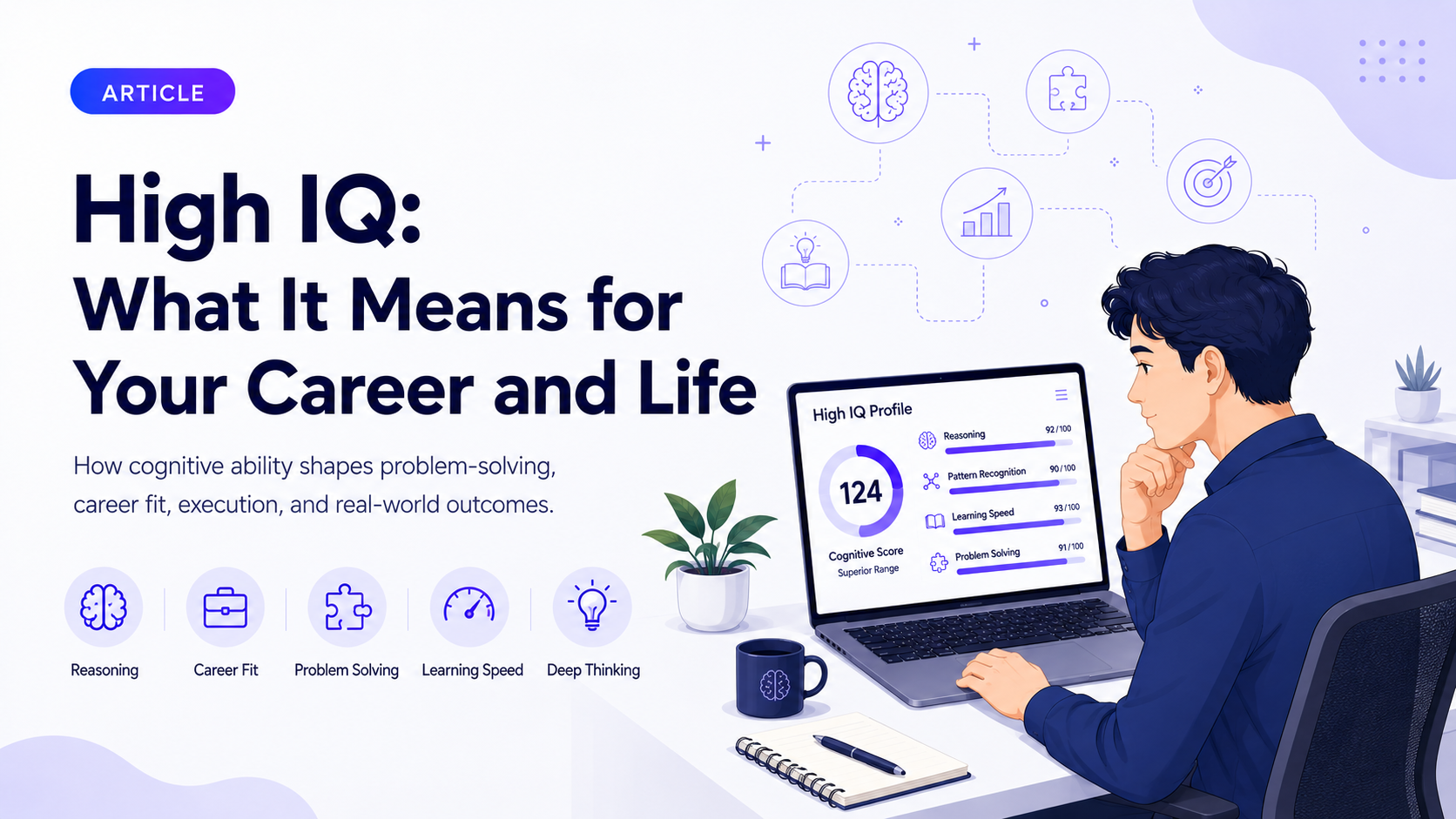
If TalentRank placed you in the 115+ range, you're in roughly the top 15 to 25 percent of the population on cognitive ability. That matters. But it's worth being clear about what the ICAR-16 can and can't tell you: it's a peer-reviewed short-form measure of reasoning ability, not a clinical IQ test. We report your score as a range, not a precise number, because the tool is a directional estimate. It tells you something real about your processing speed and abstract reasoning. It becomes most useful when you see how it interacts with your personality profile.
There's also a meaningful difference between scoring at 115 and scoring at 130 or above. At 115, you're noticeably quicker than average but not dramatically separated from your professional peers. Most of the smart people around you are in the same range. At 130-plus, the gap becomes wide enough to create its own problems: communication mismatch, difficulty finding intellectual peers, and persistent boredom in almost every structured environment. Those are qualitatively different challenges. If you're in the 115 to 125 range, your cognitive ability is a clear advantage. It's probably not the bottleneck in your career. Something else is.
High Cognitive Ability at Work
The research here is unambiguous. Schmidt and Hunter's landmark 1998 meta-analysis established cognitive ability as the single strongest predictor of job performance in complex roles, outperforming experience, interviews, and personality measures taken alone. The more complex and novel the work, the more raw cognitive ability matters.
This is why high IQ careers cluster around roles that demand continuous novel problem-solving: strategy, consulting, software engineering, medicine, law, research, data science, executive leadership, entrepreneurship, financial analysis, product management. These share a structural feature: you can't succeed in them by following a fixed playbook. The environment keeps changing, the problems keep shifting, and the people who adapt fastest win. That adaptation is cognitive ability deployed in practice.
The careers where cognitive ability predicts performance least strongly are the ones with narrow, repetitive task structures. If the job can be fully proceduralized, IQ stops being a differentiator.
The visibility problem. High cognitive ability deployed quietly, through writing, analysis, and independent thinking, goes systematically unrecognized in most organizations. Companies reward verbal fluency in meetings, relationship management, and visible output. If you're high IQ and low in Extraversion, you're producing work that your organization may not be structured to see.
The underperformance pattern. High IQ combined with low Conscientiousness produces the most common and most frustrating profile in any talent pipeline: the person who sees the answer immediately but doesn't do the sustained work to implement it. Brilliant and inconsistent. Multiple unfinished projects. A track record of starting strong and fading. If this is your pattern, more intelligence is not the fix. Environment design is. External accountability systems, reduced optionality, and tighter feedback loops will do more for you than trying to outthink the problem.
High IQ combined with high Neuroticism produces a different failure mode. The worry consumes working memory. The answer is there, but you can't access it when the stakes are high. Byrne and colleagues' 2015 research on Neuroticism and decision-making under pressure confirmed what many high-IQ people already know experientially: anxiety doesn't just feel bad, it degrades the very processing capacity you're counting on. The gap between your practice performance and your high-stakes performance is the Neuroticism tax.
A note for MBTI users: cognitive ability correlates mildly with Openness, specifically the Intellect facet identified by DeYoung and colleagues. If you're an INTJ or INTP, your Intuitive preference and your cognitive score are likely pointing in the same direction. But IQ is independent from MBTI type. ENTJs, ISTJs, and every other configuration can score in this range. Don't let your type preference become an excuse to avoid work that your type supposedly doesn't do.
If you want to see how your cognitive score interacts with your personality profile, [TalentRank's full report generates that combination analysis directly. Take the assessment here.]
High Cognitive Ability in Relationships
Processing conversations faster than the people you're in them with creates real friction. You may finish sentences, grow impatient with long explanations, or sense where an argument is going before it gets there. This is a processing speed mismatch, and left unmanaged, it reads as dismissive even when you mean nothing by it.
The "why doesn't anyone else see this?" experience is common at this range. You track implications and logical downstream effects that others in the room aren't following. That can feel isolating. It can also make you overconfident in your own read on a situation, because if nobody else is seeing what you're seeing, you might be right, or you might be missing information they have.
The flip side is that intellectual partnership, when you find it, feels great. When someone matches your processing speed, the quality of the conversation changes completely. That's worth seeking out deliberately, both personally and professionally.
High Cognitive Ability Combined with Personality Traits
Cognitive ability alone predicts less than you'd expect. Barrick and Mount's 1991 meta-analysis established that Conscientiousness adds predictive power for job performance independent of cognitive ability. The combination matters more than either component alone.
High IQ plus high Conscientiousness is the compound achiever. Sees the answer and executes consistently. This combination dominates in medicine, law, engineering, and senior leadership. The ceiling is genuinely high because both the conceptual and the operational problems get solved. [LINK: personality-iq-predict-success]
High IQ plus low Conscientiousness is the brilliant underperformer. Insight without follow-through. The fix isn't more willpower. It's structural: fewer choices, clearer commitments, external accountability. [LINK: traits/low-conscientiousness]
High IQ plus high Openness is the cross-domain synthesizer. Drawn to abstract problems, pattern recognition across fields, environments without established playbooks. Researchers, founders, and polymaths cluster here. The risk is novelty-seeking that never converts into depth. [LINK: traits/high-openness]
High IQ plus high Neuroticism is cognitive ability that degrades under pressure. Brilliant in low-stakes situations, inconsistent when it counts. The gap between practice and performance is real and addressable, but it requires confronting the Neuroticism directly rather than hoping intelligence will compensate. [LINK: traits/high-neuroticism]
High IQ plus low Extraversion is the deep worker. Intelligence deployed through written analysis, independent reasoning, and focused execution rather than verbal group performance. Systematically undervalued in most organizations. The solution is finding environments that reward output over visibility. [LINK: traits/low-extraversion]
Common Challenges and Growth Areas
The coasting trap. Raw ability that was never matched by effort creates a real skills gap, not in intelligence, but in discipline and sustained execution. If you learned early that you could figure things out at the last minute, that habit became a strategy. That strategy works until the complexity of the problems you're facing finally catches up to your processing speed. And it always does.
Impatience with others. Not everyone processes at your speed. Calibrating your communication without condescending is a genuine skill, and one that high-IQ people often develop late or not at all. Being the smartest person in the room is a lot less useful if you've alienated everyone else in it.
The too-many-options problem. High cognitive ability means seeing more possibilities in any situation. That sounds like an advantage. It often functions as paralysis. Career indecision, commitment avoidance, the feeling that no single path is interesting enough to pursue fully. These are cognitive ability problems as much as personality problems. The answer is usually to make a decision and iterate, not to keep generating options.
Overidentification with intelligence. If "being smart" is your core identity, any domain where you're not immediately excellent feels threatening. You avoid challenges where you might look slow. That's precisely backwards. The challenges that would develop you most are the ones you're currently avoiding because you might not be the best in the room.
FAQ
What does a high IQ score mean?
Scoring in the 115+ range means you're in roughly the top 15 to 25 percent of the population on general cognitive ability. In practical terms: you process new information faster than most people, spot logical gaps more readily, and are more likely to excel in roles requiring abstract reasoning and complex problem-solving. TalentRank's ICAR-16 score is a directional estimate, not a clinical diagnosis, so we report it as a range rather than a precise number.
What are the best high IQ careers?
Roles that reward cognitive ability most strongly share a common structure: they require continuous novel problem-solving rather than procedural execution. Strategy consulting, software engineering, medicine, law, data science, financial analysis, research, product management, and entrepreneurship all fit this pattern. The specific career that suits you best depends heavily on your personality profile, particularly Conscientiousness, Extraversion, and Openness.
Why do some high-IQ people underperform?
The most common reason is the interaction between cognitive ability and Conscientiousness. High IQ combined with low Conscientiousness produces insight without implementation. The second most common is the Neuroticism factor: high cognitive ability that degrades under pressure because anxiety consumes working memory. Intelligence doesn't protect against either of these patterns. Recognizing which one applies to you is the first step toward addressing it. [LINK: personality-iq-predict-success]
Sources
Schmidt, F.L., & Hunter, J.E. (1998). The validity and utility of selection methods in personnel psychology. Psychological Bulletin, 124(2), 262–274.
Barrick, M.R., & Mount, M.K. (1991). The Big Five personality dimensions and job performance. Personnel Psychology, 44(1), 1–26.
Condon, D.M., & Revelle, W. (2014). The International Cognitive Ability Resource. Intelligence, 43, 52–64.
DeYoung, C.G., Quilty, L.C., & Peterson, J.B. (2007). Between facets and domains: 10 aspects of the Big Five. Journal of Personality and Social Psychology, 93(5), 880–896.
Byrne, A., Dionisi, A.M., Barling, J., Akers, A., Robertson, J., Lys, R., Wylie, J., & Dupré, K. (2014). The depleted leader: The influence of leaders' diminished psychological resources on leadership behaviors. The Leadership Quarterly, 25(2), 344–357.